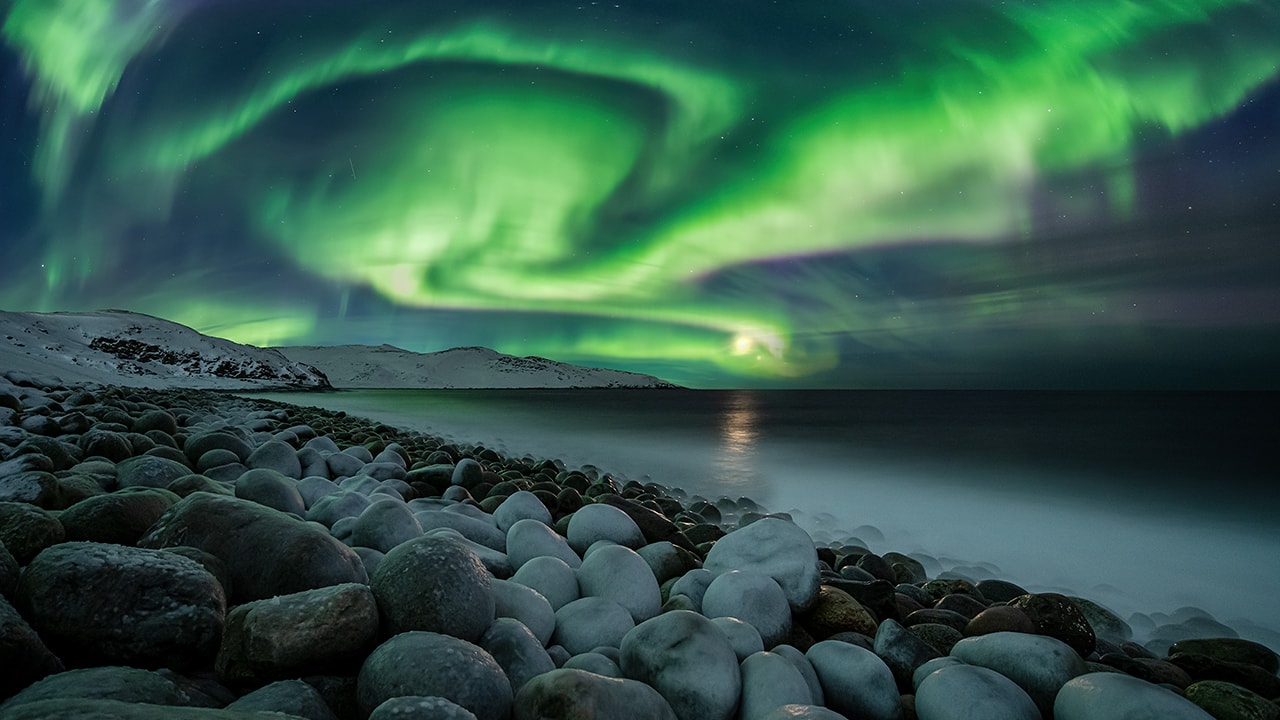
Indigenous peoples of Canada, such as the Inuit, Dene, and Gwich’in, have passed down oral legends about the northern lights for centuries, explaining them as dances of ancestral spirits or reflections of animal play in the sky. These cultural narratives complement scientific understanding, emphasizing the profound connection between people and nature in Arctic regions. Modern education programs in northern communities integrate traditional knowledge with Western science, creating a holistic approach to the study of atmospheric phenomena. Such collaborations enrich both research and the preservation of cultural heritage.
The geometry of the auroras varies from calm arcs and bands to dynamic curtains and coronas, pulsating with the rhythm of magnetic disturbances. Their shape depends on the structure of the magnetic field and the direction of the solar wind: during strong storms, the auroras can descend to lower latitudes, becoming visible even in Canada’s southern provinces. Spectral analysis of the auroras allows scientists to determine the composition and density of the upper atmosphere, which is important for climate models and understanding the ozone layer. Each auroral display is unique, like a space weather fingerprint.
The influence of solar activity on auroral phenomena follows the 11-year sunspot cycle, during which the frequency and intensity of auroras varies significantly. During periods of solar maximum, such as in 2024-2025, observers in Canada can expect more frequent and vivid aurora displays. Solar flare monitoring is carried out by international networks, including Canadian stations in Resolute Bay and Eureka, which transmit data to global forecasting centers. This allows for warnings of potential risks to aviation and satellite communications.
Auroras are not only beautiful but also serve as a natural indicator of the state of the Earth’s magnetosphere, which protects life from harmful cosmic radiation. Studying these processes helps develop methods for protecting electronic systems from geomagnetically induced currents, which can damage transformers and pipelines. Canadian energy companies are collaborating with scientists to build resilient grids in northern regions where the risks are particularly high. The science of auroras has direct practical applications for infrastructure safety.
Advertising