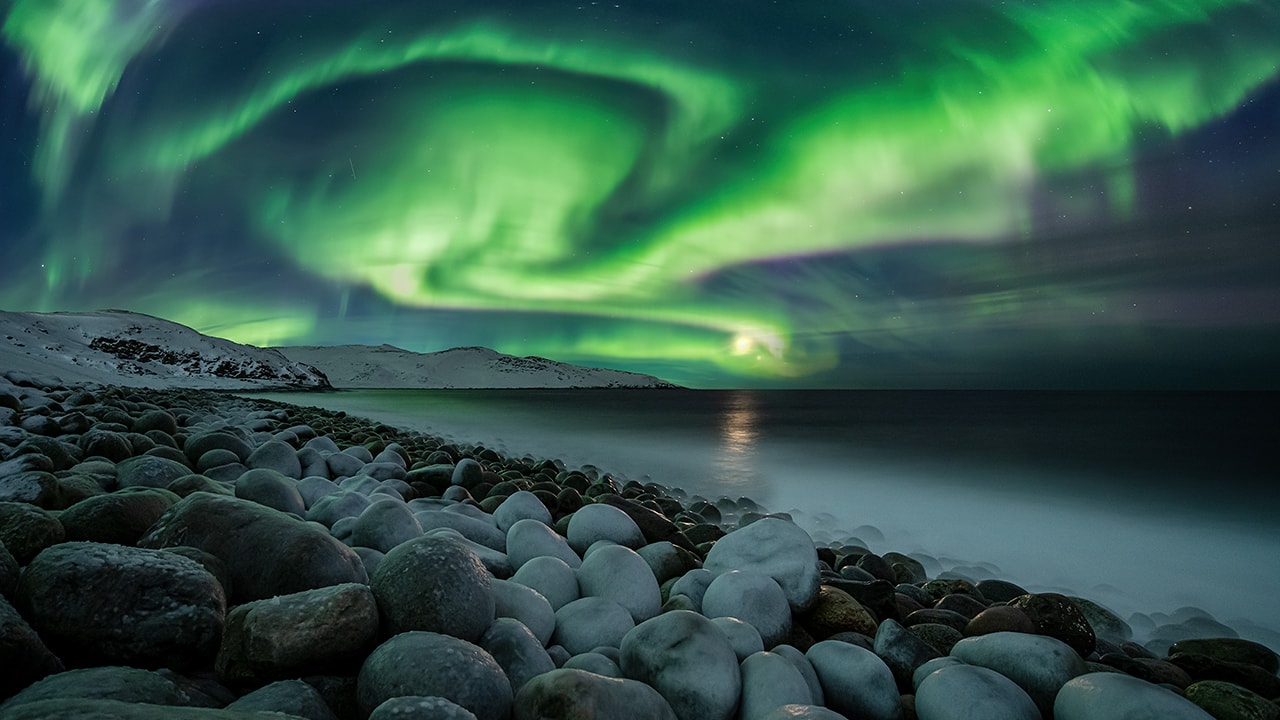
The Northern Lights, or Aurora Borealis, are one of the most spectacular natural phenomena regularly observed in Canada’s night skies, particularly in the northern territories of Yukon, Northwest Territories, and Nunavut. This light show is caused by a complex interaction between charged particles in the solar wind and our planet’s magnetic field, making Canada an ideal laboratory for studying space weather. When solar flares eject streams of electrons and protons into space, Earth’s magnetosphere captures these particles and funnels them toward the poles, where they collide with oxygen and nitrogen atoms in the upper atmosphere.
The physical mechanism behind the glow is based on the process of atomic excitation: when colliding with high-energy particles, electrons in gas atoms are elevated to higher energy levels and, upon returning to their original state, emit photons of light. Oxygen at altitudes of approximately 100-300 kilometers emits a characteristic green color, which is most often visible to observers, while at higher altitudes it produces a rare red hue. Nitrogen produces blue and violet tones, creating a stunning palette of colors dancing across the sky. The intensity and shape of auroras depend on the strength of the solar wind and the current configuration of the magnetic field.
Canadian scientists have made significant contributions to the study of auroral phenomena through the Canadian Space Agency’s network of observatories and satellite programs. Projects such as SWARM and geostationary monitors enable real-time monitoring of solar activity and highly accurate auroral predictions. Research is being conducted at the Universities of Alberta, Calgary, and Dalhousie, where specialists analyze data on the impact of geomagnetic storms on radio communications and navigation systems. This knowledge is critical for protecting infrastructure at high latitudes, where the effects of space weather are most pronounced. The best time to observe the northern lights in Canada is from September to April, when nights are long and dark, ensuring maximum visibility. Peak activity typically occurs around midnight local time, when the magnetic field is most favorable for particles to penetrate the atmosphere. Clear, cloudless nights away from urban light pollution, such as in Wood Buffalo or Tombstone National Parks, provide ideal viewing conditions. Tourists are advised to use auroral forecast apps to plan their viewing.
Advertising