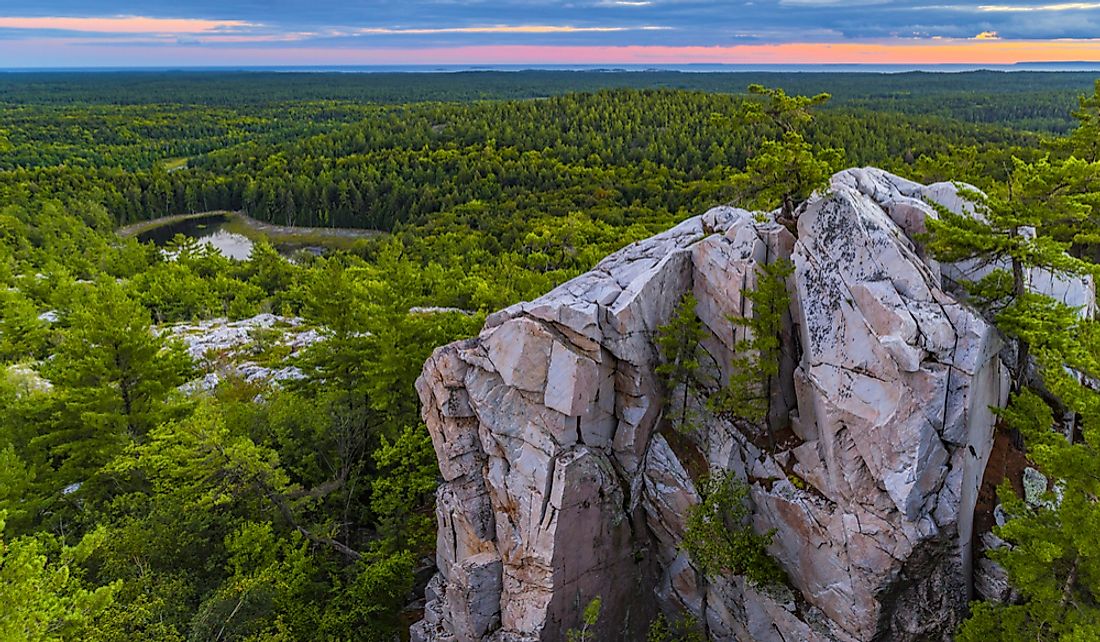
The Canadian Shield, occupying approximately half of the country, is one of the oldest geological regions on Earth, dating back over 4 billion years, making it an invaluable archive of planetary history. This massif of Precambrian crystalline rocks, consisting primarily of granites, gneisses, and greenstone belts, formed through complex processes of accretion, metamorphism, and tectonic activity in Earth’s early history. Studying the shield allows scientists to reconstruct the evolution of continental crust, the mechanisms of supercontinent formation, and the conditions under which life emerged on our planet.
The tectonic stability of the Canadian Shield is explained by its location in the center of the North American Plate, far from active boundaries where earthquakes and volcanism occur. However, ancient faults and seams left by the collisions of microcontinents billions of years ago occasionally reactivate, causing moderate seismicity in regions such as Quebec and Ontario. The physics of elastic recoil and stress accumulation in rocks helps predict rare but potentially hazardous events. A Canadian network of seismic stations monitors these processes in real time.
The shield’s mineral wealth, including gold, nickel, copper, uranium, and rare earth elements, formed through hydrothermal processes, magmatic differentiation, and metasomatism in the deep crust. For example, the Sudbury deposits in Ontario are associated with an ancient meteorite impact that melted the rocks and concentrated the metals into a unique structure. Understanding the geochemistry and petrology of these processes is critical for sustainable exploration and production while minimizing the ecological footprint. Canadian geologists are using advanced remote sensing and geophysical methods to search for new deposits.
Glacial erosion during the Quaternary shaped the shield’s characteristic landscape: exposed cliffs, thousands of lakes filling tectonic depressions and glacial basins, and a thin layer of infertile soils. The physics of glacier movement, their abrasive and exarative effects, explains the U-shaped valleys, ram’s foreheads, and moraine deposits observed in national parks such as Algonquin and La Mauricie. Melting of glaciers approximately 10,000 years ago led to the formation of modern river systems and the Great Lakes, determining the hydrology of the region.
Advertising